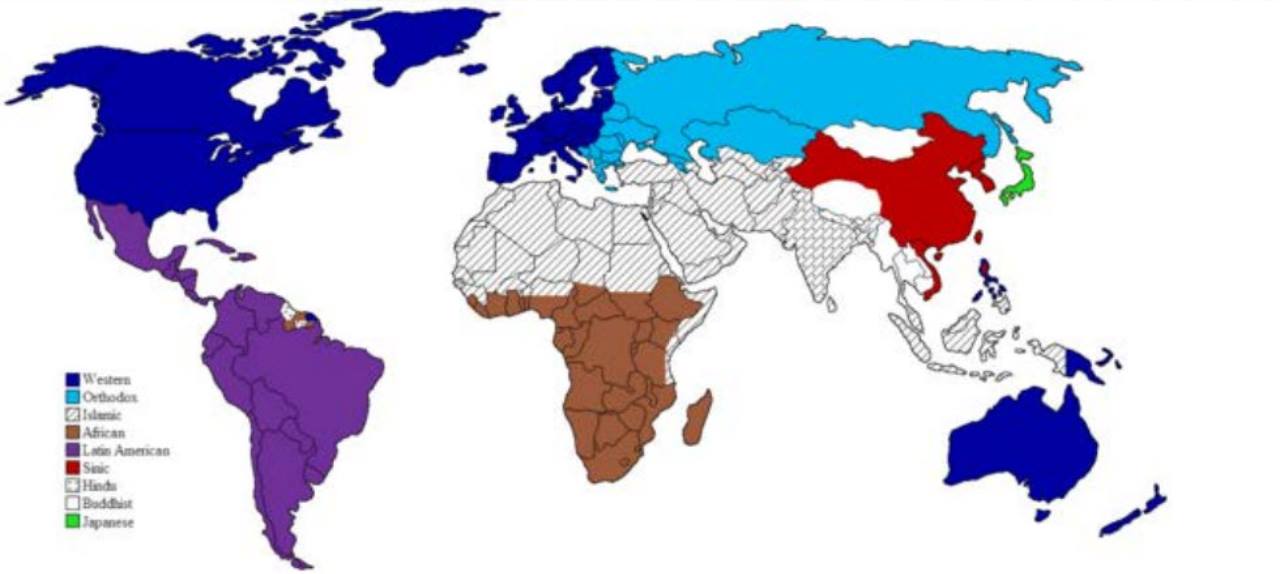
According to Samuel P.Huntington’s great book The Clash of Civilizations and the Remaking of World Order it’s far more useful to think of the human world as divided into 9 great cultures rather than as 200 or so sovereign nations.
Those cultures – Western, Orthodox (Russian), Islamic, African, Latin American, Sinic (Chinese), Hindu, Buddhist, and Japonic – are persistent and profoundly influential in ways that national borders and national institutions aren’t.
Huntington argues that these 9 cultures are the most meaningful current expressions of the human animal’s inherent social imperatives, and that the logic of competition between these cultures explains and illuminates human history far better than competing notions, particularly those (like Marxism and liberalism) that assume an up-and-to-the-right direction to the arrow of history.
It is my hypothesis that the fundamental source of conflict in this new world will not be primarily ideological or primarily economic. The great divisions among humankind and the dominating source of conflict will be cultural. Nation states will remain the most powerful actors in world affairs, but the principal conflicts of global politics will occur between nations and groups of different civilizations. The clash of civilizations will dominate global politics. The fault lines between civilizations will be the battle lines of the future
The Clash of Civilizations
Huntington offers six main explanations for why civilizations will clash:
– Differences among civilizations are too basic in that civilizations are differentiated from each other by history, language, culture, tradition, and, most important, religion. These fundamental differences are the product of centuries, so they will not soon disappear.
– The world is becoming a smaller place. As a result, the interactions across the world are increasing, and they intensify civilization consciousness and awareness of differences between civilizations and commonalities within civilizations.
– Due to the economic modernization and social change, people are separated from longstanding local identities. Instead, religion has replaced this gap, which provides a basis for identity and commitment that transcends national boundaries and unites civilizations.
– The growth of civilization-consciousness is enhanced by the dual role of the West. On the one hand, the West is at a peak of power. At the same time, a return-to-the-roots phenomenon is occurring among non-Western civilizations. A West at the peak of its power confronts non-Western countries that increasingly have the desire, the will and the resources to shape the world in non-Western ways.
– Cultural characteristics and differences are less mutable and hence less easily compromised and resolved than political and economic ones.
– Economic regionalism is increasing. Successful economic regionalism will reinforce civilization-consciousness. Economic regionalism may succeed only when it is rooted in a common civilization
The West versus the Rest
Hauntington suggests that in the future the central axis of world politics tends to be the conflict between Western and non-Western civilizations.
Buy the book:



 New European