If it does not change the way you act, feel or think, no education took place
By Bill Clinton

If it does not change the way you act, feel or think, no education took place
By Bill Clinton
If you can pronounce correctly every word in this poem, you will be speaking English better than 90% of the native English speakers in the world.

Via Tickled
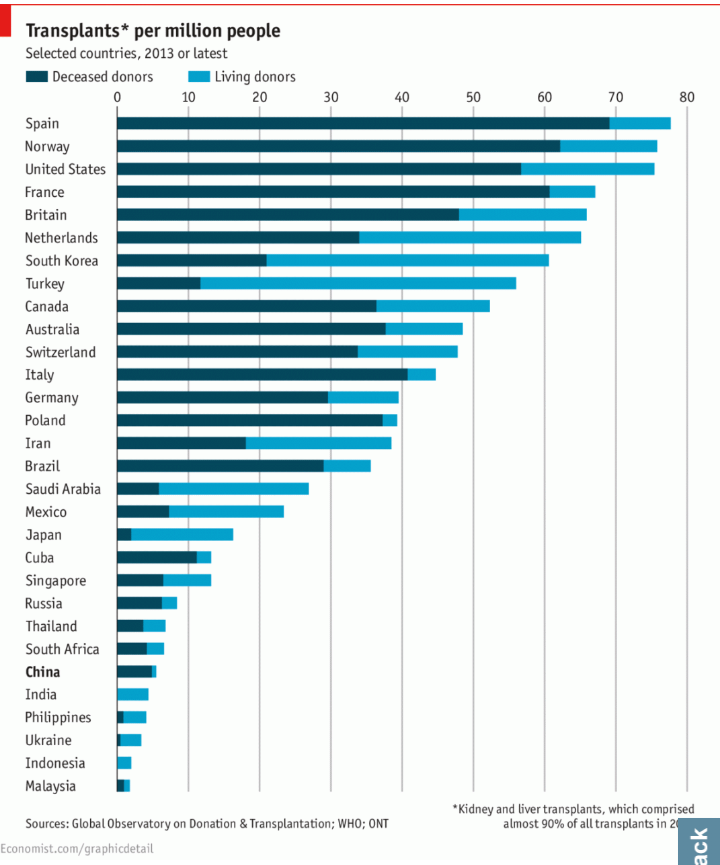
At any one time, hundreds of thousands of people around the world are waiting for an organ transplant.
Several things conspire to make supply of organs fall far short of demand. Organs deteriorate rapidly after death; transplants generally require the consent of the individuals involved (or that of their families); and in almost every country organs cannot be legally bought or sold.
In China, where each year around 300,000 people are put on a transplant waiting-list, one way of relieving this pressure has been to “harvest” organs from executed prisoners. Once the main source of transplanted organs, the share from prisoners is reported by the government to have halved in recent years (mirroring what is believed to be a large decline in executions). From January 1st, the government is expected to put an end to such organ harvesting altogether, and all transplanted organs will need to come from volunteered sources. The new system would still be vunerable to abuse: prisoners could be pressured into donation, for example. But if forced harvesting stops, the public’s willingness to donate must increase from relatively low levels to make up the difference.
China is not alone in having low transplant rates in Asia—even richer countries such as Japan and Singapore fall far short of Western countries. Most transplants in these countries (China is an exception in this regard) also tend to come from live donors, compared with under a third in the West. That suggests there is a lot of room to increase the deceased-donor supply, whether through public-information campaigns or “opt-out” donor-consent regimes (which presume everyone’s consent unless they express otherwise). China is considering a legal standard for brain death, enabling exploitation of intact organs while a patient’s heart is still functioning but recovery is deemed impossible.
Such efforts run into local obstacles, however. Religious and cultural beliefs about the ‘integrity’ of the body are often blamed for low organ-donation rates in China. Another problem is more down-to-earth: although four-fifths of respondents to a 2012 poll in Guangzhou thought donating organs was “noble”, a slightly higher number feared their body parts would end up for sale. After years of taking prisoners’ organs without permission, the government must now convince the public that their donated organs will be used in accordance with their wishes. government must now convince the public that their donated organs will be used in accordance with their wishes.
Spain leads the world with 80 organ donations and transplant per million people.
Via The Economist
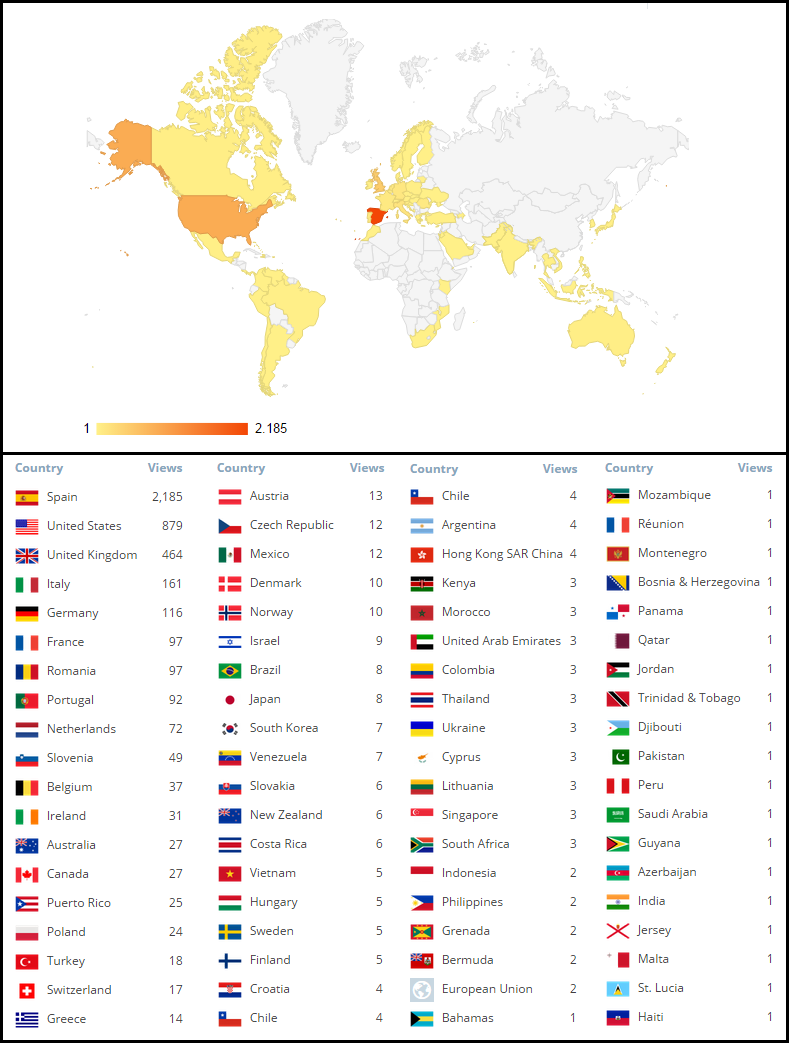
The New European Blog has completed two months from the day it started its adventure in the online world.
The statistics of visitors and page views are impressive: 4701 readers from 76 countries in 5 continents.
Thank you for your interest in our blog. We promise that we intend to continue with our purpose to research and publish content that appeals both to your heart and mind, with an original, matter-of-fact and genuine global perspective.
The most popular post in the past two months is: What Every European Country Needs to Improve
Read the latest posts in our Blog
Section on Aphorisms
Section on Trendlines
Section on Book Reviews
Section on Guest Posts
The Latest Posts
Contra the prevailing belief, “success” isn’t being on top of a hierarchy, it is standing outside all hierarchies.
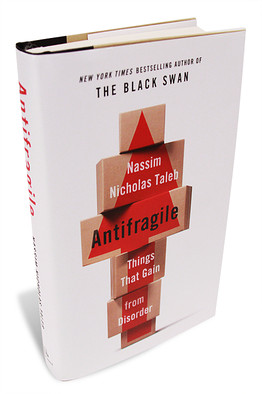
You don’t need a physics degree to ride a bicycle. Nor, Nassim Nicholas Taleb realized one day, do traders need to understand the mathematical theorems of options trading to trade options. Instead traders discover “heuristics,” or rules of thumb, by trial and error. These are then formalized by academics into theorems and taught to new generations of traders, who become slaves to theory, ignore their own common sense and end by blowing up the system. In a neat echo of its own thesis, Mr. Taleb’s paper making this point sat unpublished for seven years while academic reviewers tried to alter it to fit their prejudices.
Mr. Taleb, a former trader and expert on probability, tells this story in “Antifragile: Things That Gain from Disorder” to illustrate the point that “we don’t put theories into practice. We create theories out of practice.” It is a startling insight, which he applies not just to finance but to medicine, science and philosophy. Successful medicine was a “craft built around experience-driven heuristics” that had to fight against entrenched, top-down theorizing from Galen and other wise fools.
Discovery is a trial and error process, what the French molecular biologist François Jacob called bricolage. From the textile machinery of the industrial revolution to the discovery of many pharmaceutical drugs, it was tinkering and evolutionary serendipity we have to thank, not design from first principles. Mr. Taleb systematically demolishes what he cheekily calls the “Soviet-Harvard” notion that birds fly because we lecture them how to—that is to say, that theories of how society works are necessary for society to work. Planning is inherently biased toward delay, complication and inflexibility, which is why companies falter when they get big enough to employ planners.
If trial and error is creative, then we should treat ruined entrepreneurs with the reverence that we reserve for fallen soldiers, Mr. Taleb thinks. The reason that restaurants are competitive is that they are constantly failing. A law that bailed out failing restaurants would result in disastrously dull food. The economic parallel hardly needs spelling out.
The author is a self-taught philosopher steeped in the stories and ideas of ancient Greece (a civilization founded, of course, by traders like Mr. Taleb from Lebanon, as Phoenicia is now known). Anti-intellectual books aren’t often adorned by sentences like: “I have been trying to bring alive the ideas of Aenesidemus of Knossos, Antiochus of Laodicea, Menodotus of Nicomedia, Herodotus of Tarsus, and of course Sextus Empiricus.” So he takes his discovery—that knowledge and progress are bottom-up phenomena—and derives an abstract theory from it: anti-fragility.
Something that is fragile, like a glass, can survive small shocks but not big ones. Something that is robust, like a rock, can survive both. But robust is only half way along the spectrum. There are things that are anti-fragile, meaning they actually improve when shocked, they feed on volatility. The restaurant sector is such a beast. So is the economy as a whole: It is precisely because of Joseph Schumpeter’s “creative destruction” that it innovates, progresses and becomes resilient. The policy implications are clear: Bailouts risk making the economy more fragile.
Biological evolution, too, is anti-fragile. The death of unfit individuals is what causes a species to adapt and improve. The body is anti-fragile: Without stress it weakens. To build muscles, you must push them to the point of failure. Though he has no truck with homeopathy, Mr. Taleb is intrigued by hormesis, an old idea, now enjoying a revival, that a small dose of a harmful substance is actually beneficial.
It follows that, in Mr. Taleb’s world, the greatest sin is to be a “fragilista,” somebody who encourages an institution to become fragile. This word is defined in the book’s glossary thus: “somebody who causes fragility because he thinks he understands what’s going on. See Iatrogenics.” The latter term is from medicine, meaning when doctors do more harm than good, for example, by bleeding the patient in the past, or by putting ice on swellings today.
The Federal Reserve, in Mr. Taleb’s view, is an iatrogenic institution run by fragilistas doing more harm than good by trying to root out randomness. This might seem a cheap shot were it not for Mr. Taleb’s track record in spotting some of the ingredients of the recent financial crisis. In particular, after 2003, he took a lot of criticism because “I kept telling everybody who would listen to me, including random taxi drivers (well almost), that the company Fannie Mae was sitting on a ‘barrel of dynamite.'” He has little mercy for the Keynesian economist Joseph Stiglitz and the Orszag brothers, Peter and Jonathan, economic consiglieres to Democratic administrations, who insisted around the same time that the probability of default in the government-sponsored enterprises was “so small that it is difficult to detect.”
As this illustrates, Mr. Taleb doesn’t suffer fools, a category in which he includes virtually the entire profession of economics and many other academics. Consider the definition of “touristification,” from his glossary: “the attempt to suck randomness out of life. Applies to soccer moms, Washington civil servants, strategic planners, social engineers, ‘nudge’ manipulators, etc.” The opposite, strategy, which he approves, is to embrace “optionality“—like a traveler without an itinerary feeding off randomness by grabbing opportunities as they arise. The author’s heroes, from Thales of Miletus, the first Western philosopher, to his intuitive street-wise trader friend Fat Tony, are people who find out how to do things empirically.
This is a bold, entertaining, clever book, richly crammed with insights, stories, fine phrases and intriguing asides. You will want to read it again. And again.
Buy the book:
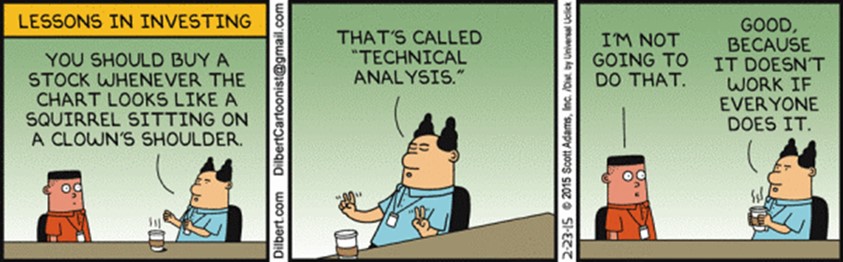
Confused about how and when to select the correct stock to buy as an investment? This should help in the process…
Technical Analysis
Fundamental Analysis
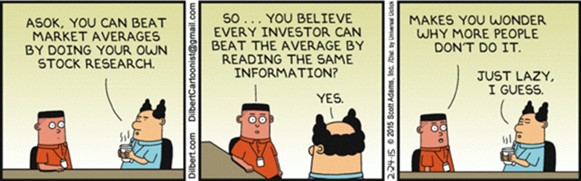
Via Dilbert.com
Democracy is three wolves and a lamb voting to elect a representative amongst them who decides who gets eaten.
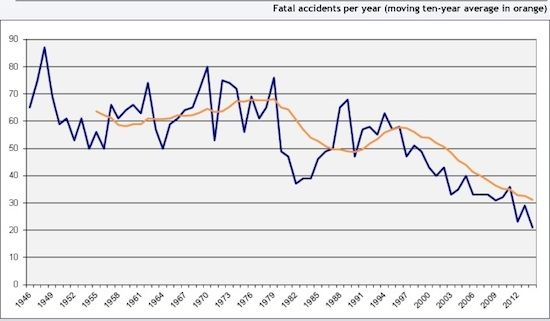
As worlwide media provide extensive coverage of the fatal accident of the Germanwings flight that crashed into the French Alps killing 150 passengers and staff on board, it is important to understand the trendlines and not to be conditioned by the headlines: airplanes are still one of the safest means of transportation.
Evolution of Aircraft Fatal Accidents
Over the past 40 years, the trend is clearly decreasing.
Evolution of Annual Departures and Flight Hours
The total number of fatal accidents is falling within the context of a rapidly increasing number of hours that flights are airborne. That is a clear sign that flying has never been safer.

Casualties in Aircraft Crashes in 2014
The great majority of fatal accidents involved small planes flying internal routes in developing countries. The two major commercial airline accidents with more than 100 casualties that happened in 2014 were not caused by technical failures: in the skies over Ukraine a plane was shot down by a rocket and the Indonesian crash was due to a human mistake of the pilot.
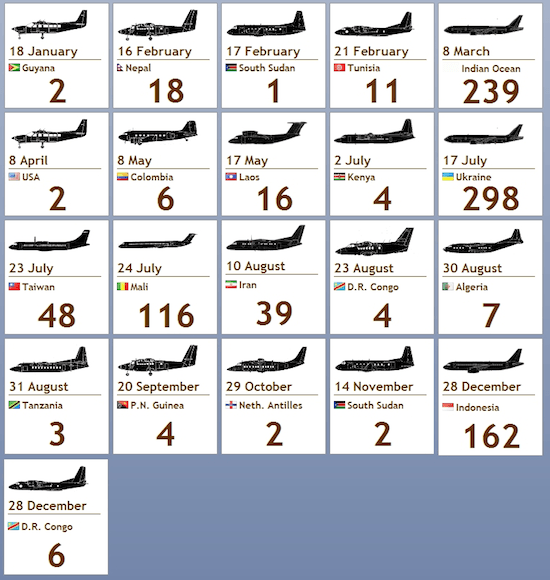
Analyzing the trendlines, we can conclude that flying has never been safer.
Muscles without strength, friendship without trust, opinion without risk, change without aesthetics, age without values, food without nourishment, power without fairness, facts without rigor, degrees without erudition, militarism without fortitude, progress without civilization, complication without depth, fluency without content; these are the sins to remember.
And, of course, religion without tolerance.
 New European